Reflection On Our DH Project

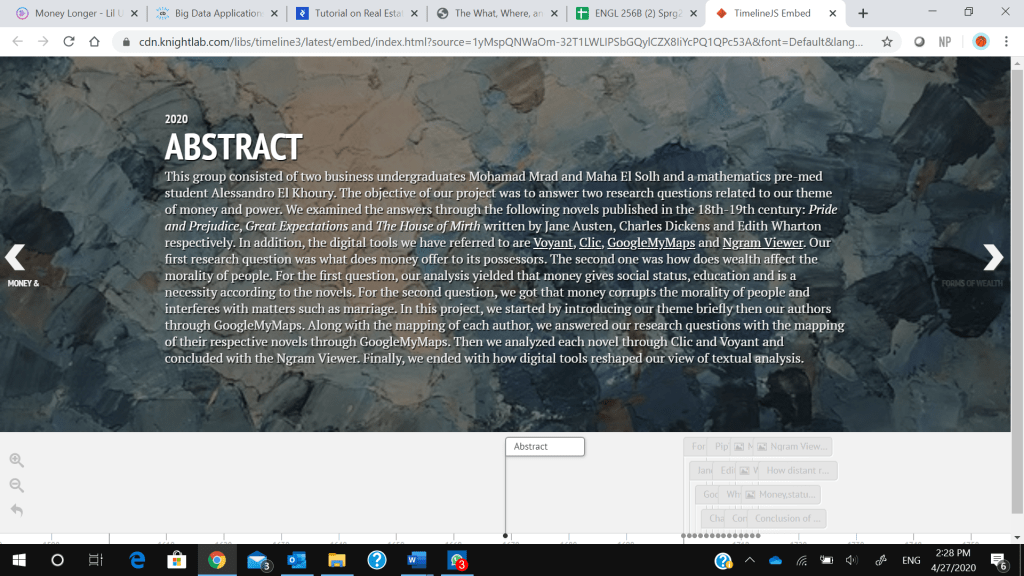
Today is the day, the day we are posting our final blog for this course, our English 256B course. We have come along way since the beginning of this semester, specially while everything happening in the world from the corona pandemic to a possible economic recession. In this final blog we will write a reflection on our final Dh Project, which by the way if you haven’t seen it, here you go Money & Power. Our reflection will include what is and why we chose our theme and our novels, the goals of the project and whether these goals have changed with time and research, and finally and most importantly, the new things we have learned about our topic in addition to how digital tools helped us learning along the way. Since this is our last Blog let’s make it worth it.

Why this theme and authors?

            As a theme for our DH project, we have chosen Money & Power in the works of Charles Dickens, Jane Austen and Edith Wharton. In exact, we chose one novel per author, Pride & Prejudice, Great Expectation and The House of Mirth, Respectively. At First, we chose a corpus consisting of novels written by Nicollo Machiavelli. However, with some more research we found it more interesting if we talked about a theme rather than choosing one author. Therefore, since Mohamd and Maha are business students (they like money) we found it interesting to address the theme of Money & Power. After some research, we found those three authors who are known for their writings on such concept. We got the green light from professor Najla and the journey started.
A screenshot of a computer

Description automatically generated

Our goals:

A picture containing drawing

Description automatically generated

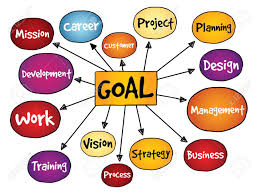
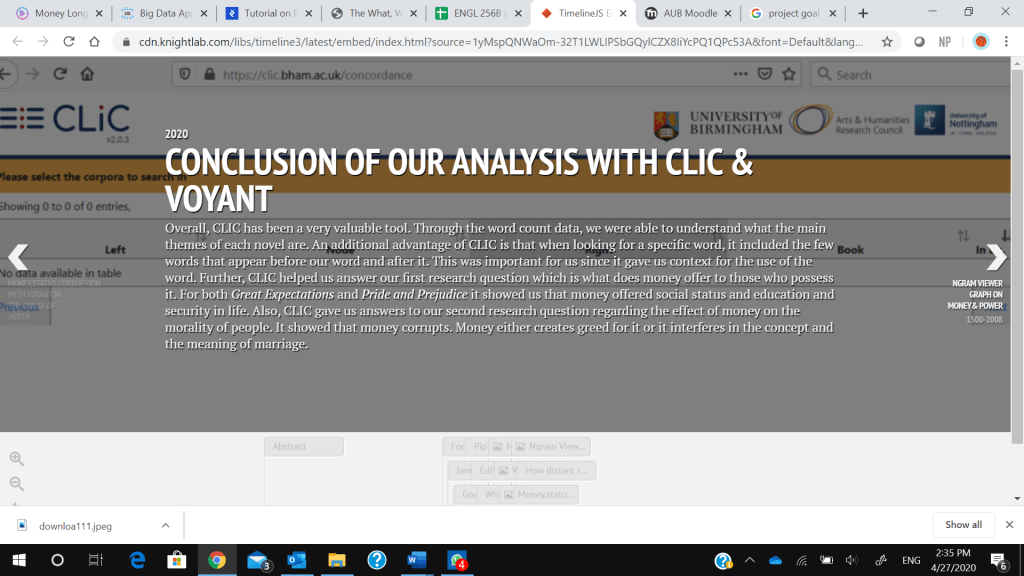
            The main goal of our project consisted of two research questions related to our theme, what money offers to its possessor and how does money affect morality. We believe those two questions are important to ask as they are part of the major effects of money in society. In order to accomplish this goal, we had three sub-goals. The first one was to present a mapping of each novel with GoogleMyMaps. The second was to analyze each novel with Voyant and Clic. After analyzing all three novels, we were able to produce solid answers to each of our research questions. All three novels indicated that money brings social status and it also guarantees education.  Regarding our second research question, we obtained that money corrupts one’s morality. This was seen in Great Expectations’ Pip. After receiving money form an unknown source, he started acting in a condescending way towards Joe. This was also seen in Estella’s attitude towards Pip the first time they met. On the other hand, money also interferes with marriage as seen in all three novels. It turns itself into the deciding factor for whether marriage will happen or not. As such, it is the foundation, such as love and chemistry on which a successful marriage is built. Therefore, after digging out all the relevant information we needed from our digital humanities tools, we were able to generate answers to both of our research questions. Consequently, we believe that we were able to achieve the destinated goal of our project.
A screenshot of a social media post

Description automatically generated
A screenshot of a computer

Description automatically generated

            Furthermore, we should note that we did slightly modify the trajectory of our project. Indeed, after we deeply analyzed our novels, we decided to give more emphasis to our second research question; how money affects the morality of people. In fact, while the three novels did give us answers to our first question, we noticed that the second question constituted a more prominent topic in all three novels. We see it in how money affects marriage in the plots, how Lily seeks it to secure herself financially, how Pip sees money as the only way for him to be able to marry Estella and how the Bennets prioritize marriage for the purpose of material gain. 

How DH tools gave us new knowledge on our Topic and Authors:

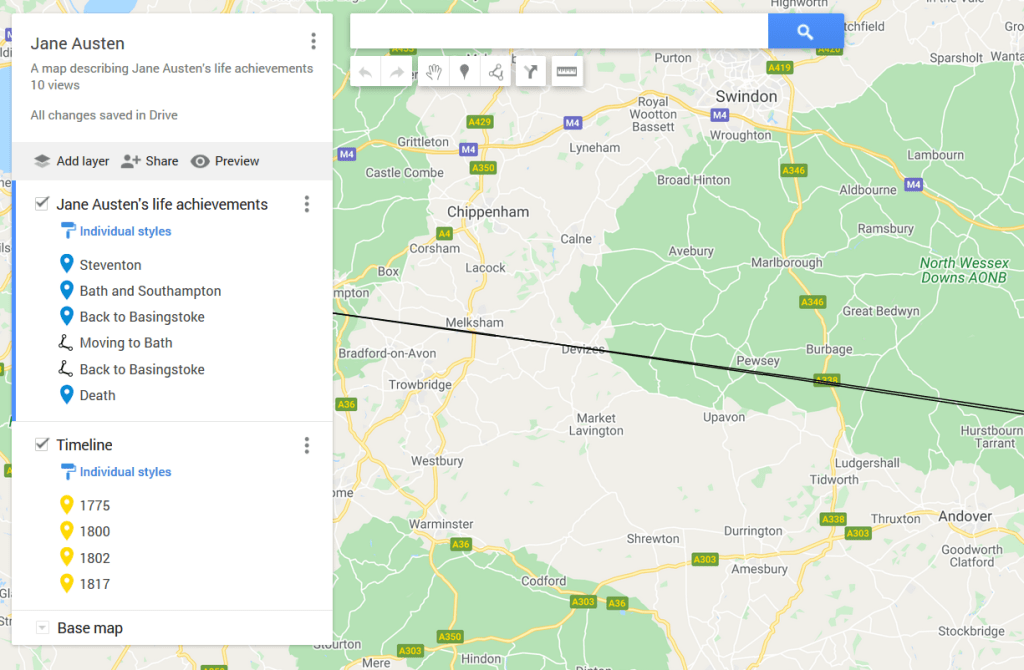
            A casual reader would skim through a novel as an enjoyable activity that piques his interest. However, approaching novels from a different perspective allows the individual to gain a deeper understanding of the reasons behind the author’s purpose. For example, by mapping the works of Jane Austen and the stages of her life, we were able to correlate the impact of the areas she lived in and travelled to, with the outcome of her work. It gave us a new perspective and understanding of the environment Austen resided in and the family she grew up with. Austen used her life surroundings to add more value to her content. Moreover, from today’s perspective, one would consider most characters in Austen’s work to be shallow and money-driven when it comes to their reliance on marriage as a solution for economic security. However, by looking into the culture at the time, and the impact money had on the social status of everyone, one would consider that behavior to be quite logical and understandable. Furthermore, by developing a timeline and mapping Austen’s work, along with Charles Dickens’ and Edith Wharton’s, we were able to observe a continuity in this money-driven ideology.
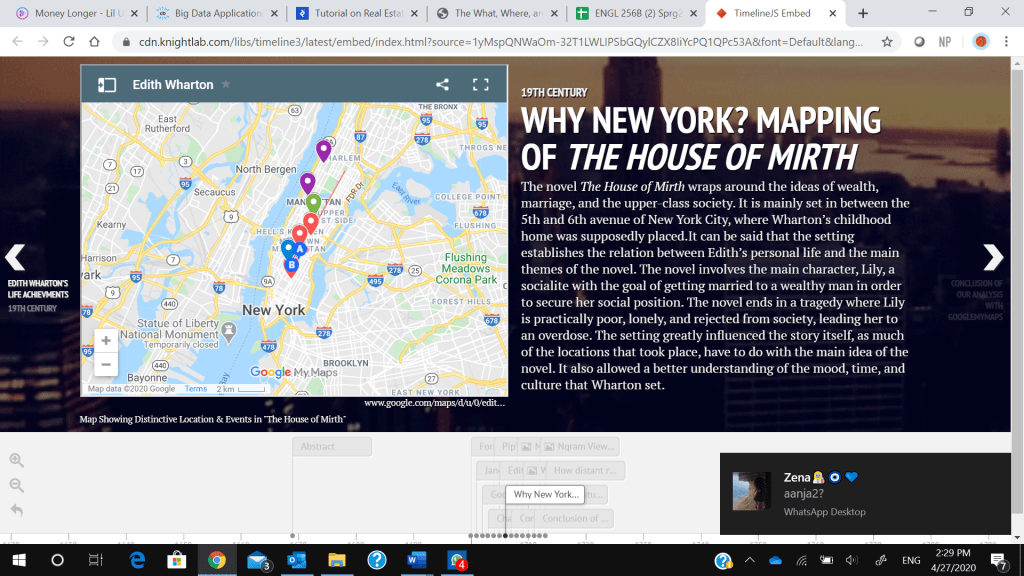
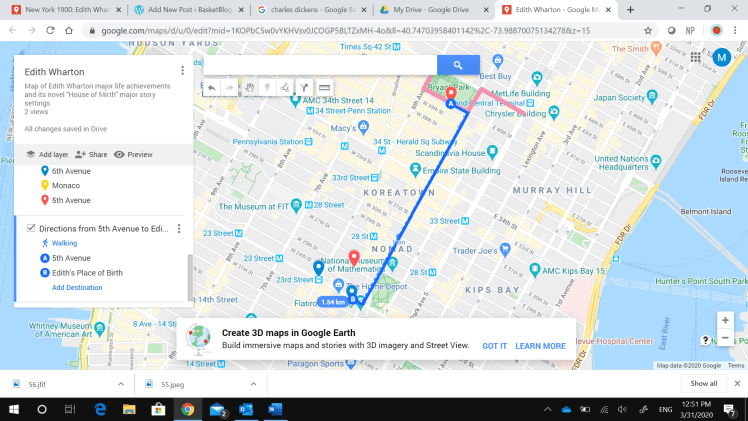
Furthermore, in Wharton’s work, one can observe a certain vagueness when it comes to geographical descriptions of her character’s locations and origins. Thus, showing that the author adequately described places she knew from experience. However, a naked eye could have not noticed this matter, but it was brought to our attention after mapping her life achievements and novel.
A screenshot of a computer screen

Description automatically generated

            At the time Dickens was writing, people of noble birth were no longer the only wealthy members of the society. Middle-class people were able to gain a new social status and rise to wealth by running a successful business, such as factories, and through hard work. The importance of money is evident in Dickens’ work, but the means to reach wealth and status were different. Moreover, it also fostered a negative mentality which is that anyone can succeed and become wealthy with required efforts, and therefore, poor people were viewed rather as lazy.

            From our project, we were able to develop a general understanding of marriage to each gender at the time. For women, marriage becomes a mean for social and economic security, as well as being owned. However, for men, marriage is a mean to utilize their wealth, thus allowing them to choose a wife freely and dominating her. Marriage was considered as an acquisition and an ownership of a woman.

A screenshot of a computer

Description automatically generated

            The digital tools we referred to were extremely helpful in building our analysis. GoogleMyMaps showed us that great writers may fabricate fictional stories. However, they use settings and emotions derived from real surroundings. Clic and Voyant pointed us keywords in the novels related to our theme as well as quotes that allowed us to answer our research questions. The Ngram Viewer was also helpful as it drew to us the correlation between the words ‘’money’’ and ‘’power’’ throughout the 18th and 19th centuries. Furthermore, the platform of our project, TimelineJS, organized all our information and visuals into one place with style and clarity. TimelineJS is divided into slides and a time axis which allowed us to partition our work into well-defined categories. Thus, the digital tools previously mentioned helped us gather all the information while TimelineJS arranged it into a clear summary of our work.

A screen shot of a computer

Description automatically generated

Our DH Project

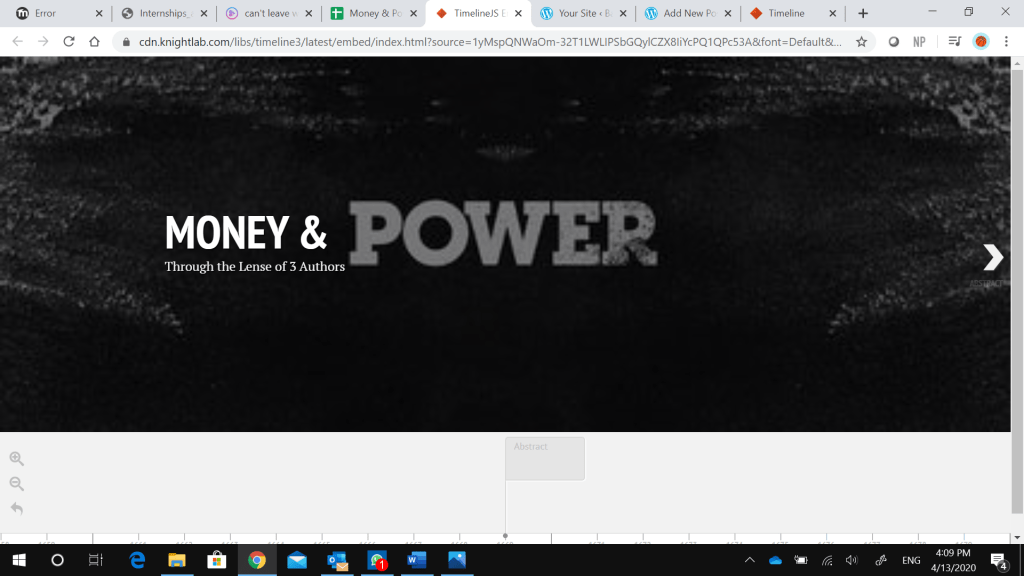
You can now check my team’s and I final Digital Humanities Project. Our chosen theme is the one of Money & Power Through the works of Edith Wharton, Charles Dickens & the infamous Jane Austen.

Follow the link below :

My Resume

Mohamad Mrad

Beirut, Lebanon

https://www.linkedin.com/in/mohamad-mrad/

(+ 961) 76028189 | mnm30@mail.aub.edu |

EDUCATION

American University of Beirut, Suliman S. Olayan School of Business, Lebanon Bachelor’s Degree in Business Administration – Business Information and Decision Systems Concentration   2016 – Present  

Lycée Du Musée, Lebanon

Lebanese Baccalaureate in Life Sciences  2001 – 2016  

EXPERIENCE

Transmed                                                                                                                                                          Sales & Marketing Intern  07/19-09/19

  • Learned the role of a sales executive.
  • Promoted company’s products to customers.
  • Attended sales meetings with Sales & Marketing Managers.
  • Tracked and presented a project on impulse categories in supermarket channels.
  • Received the best project/Intern award among 8 other interns.

SugarNSpice (Food Startup)                                                                                            Co-Founder  08/17 – Present

  • Ensured cost tracking and cost control through real costs and cash flow updates.
  • Helped establish a pricing strategy of different product lines.
  • Prepared and tracked monthly payments and invoices.
  • Closed deals with suppliers and distributors.

Riyadi Basketball Club, Beirut                                                                              Basketball Coach      05/16 – Present

  • Trusted with 20+ players to teach advanced basketball skills enhancement.
  • Coached children aged 6-14 in basketball for 48 hours a month.
  • Emphasized the importance of commitment, teamwork, leadership and communication during practices

Dent De Lait, Beirut                                                                                                 Summer Camp Monitor    07/15 & 07/16

  • Lead teams of 7-10 children in various intellectual and physical activities.
  • Helped organize a summer camp program.

AWARDS & CERTIFICATIONS

  • Thomson Reuters EIKON Certification
  • University Sports conference JV men’s Basketball league MVP for the year 2017-2018
  • University sports conference JV men’s Basketball league Champion for the year 2017-2018
  • Certification in Time Management and Business Writing.
  • Fullbridge U Program Certification A 2-month career preparedness course focused on effective communication, teamwork, Design thinking, and critical work management skills.

EXTRA CURRICULAR ACTIVITIES

  • Volunteer Summer camp Basketball coach at the American Community School (ACS)                                        08/17 & 08/18
    • Coached 15+ students of various ages basic basketball skills and concepts
  • Captain of the AUB Basketball Team for the years 2017-2018 & 2018-2019
  • Member of the AUB Youth Club

SKILLS

COMPUTER SKILLS: MS Office (Word, Excel, PowerPoint), Thomson Reuters Eikon program, @Risk.

LANGUAGES: Fluent in Arabic, English, and French (writing, reading and speaking).

SOFT SKILLS: Leadership, Teamwork, Decision Making, Market Research, Critical Thinking, Communication.

Our Journey With TimelineJs

Firs of all, we would like to thank our audience outside our 4-bedroom walls, for taking the time to read this blog. We hope you and your families are staying safe during this COVID-19 outbreak.

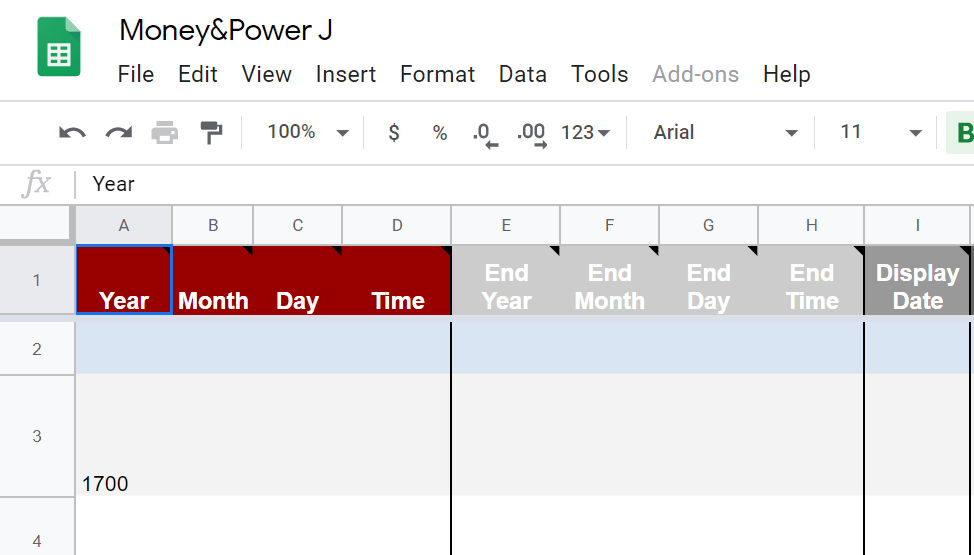
In this blog we will be discussing TimelineJS, another tool offered by digital humanities throughout this semester. We have had the opportunity to use TimelineJs twice this semester, in which the first time we worked on the platform, it was individual and practice for our Digital humanities project, which we will be working on as a group. For those who are unfamiliar with this platform, TimelineJS is a visual representation tool on the web, similar to a power-point presentation. However, the main aspect of this tool is time. It is most beneficial when you display your content as a story in which every slide represents an event stamped by a date. As you can see in the following picture, it is favorable if every slide includes a start date, end date, and a display date. Nevertheless, the coolest thing about this platform is that regardless whatever story, project, presentation etc. you intend to represent, it allows you to customize it by putting a plain color as a background. Also, in case you want to spice things up, you can always add a photo. If you really want to impress the crowd, you can even embed a live moving giphy in the background. In addition to adding a background, you can add media to put some pictures to words and the options vary from pictures, GoogleMyMaps, to SoundCloud music, and YouTube videos.

How it works:

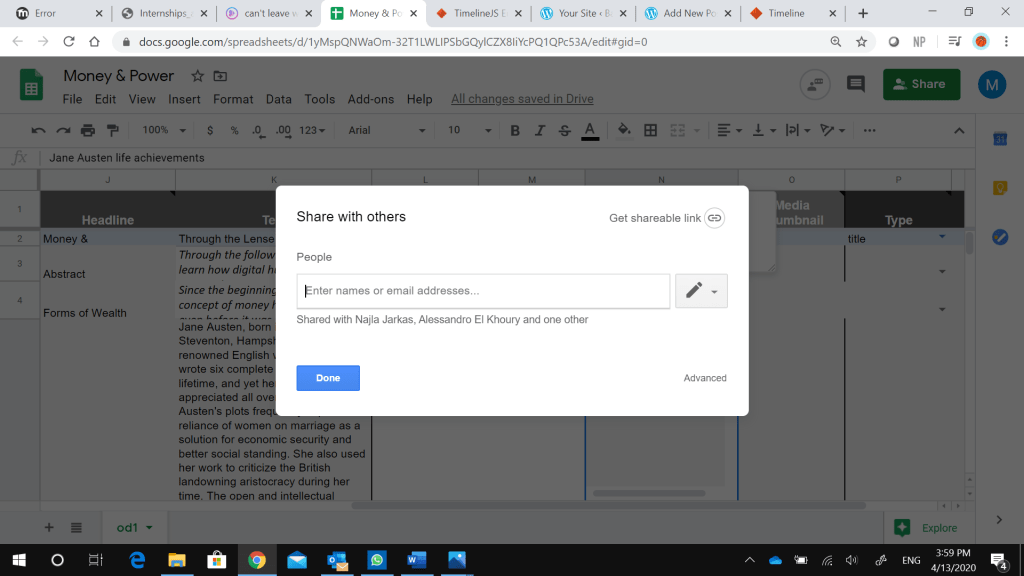
  Creating a TimelineJS is super easy and fun. First, you need to access your Gmail account, go to TimelineKnightlab, click on make a timeline, and access your google drive. At this stage, the site has already shared with you a spreadsheet to access with examples embedded in it. In order to add content, type a headline for your text in the “Headline” column, and add your paragraphs in the “Text” column. As mentioned earlier, to be able to customize your presentation, you will need to embed the image address from online pictures, giphy, videos etc.. To acknowledge their sources, copy-paste the website link you got your sources from into the “Media Credit” Column. In addition, people can share the excel sheet with other people to view and edit depending on whether it’s a group project or if they just need a bit of help. To share, just click the share button and add the person’s Gmail and you’re good to go!

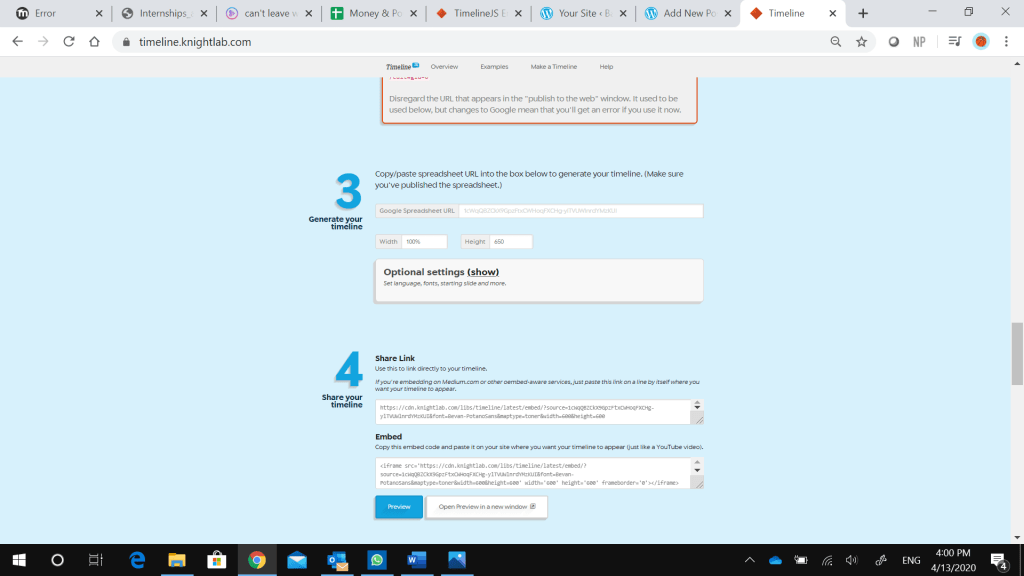
   Once done with the project, it is time to release this beauty to the public. You can achieve this final step by pressing file, publish to the web , and copying the link displayed in front of you. The second step is to paste this link into Timelineknightlab “step 3” which will generate a new link in “step 4” and then click on preview. Finally, share the link with your friends for them to view your eye-catching project.

 As you guys can see, TimlineJS is a straightforward and user-friendly digital tool. We can successfully say that this tool is the most rewarding of them all. Nonetheless, it is bittersweet, as moving between columns serves as a disadvantage when it comes to writing bigger paragraphs. Big paragraphs will make the spreadsheet less comfortable and more intricate to navigate and edit. In addition, it is known that a font type can set the mood of the text and italicizing a word can distinguish it from the crowd. However, these editing types are not applicable in TimelineJS.

At this point, you would have got a hold of how to navigate and work with TimelineJS. Before being introduced to TimelineJS, our team’s goal was to prepare a simple presentation using PowerPoint, a classic tool utilized by many. This would involve multiple slides with big bulks of writing, which eventually would cause the viewer to lose focus and interest in the topic presented. It has been an essential software throughout the years, but it has shown to be limited in terms of media attachment and flexibility. The aim with PowerPoint was to deliver the information as clear as possible in the simplest of ways in order to maintain the reader’s interest. Thus, we didn’t think beyond the facts and information as to what we can deliver visually.

TimelineJS allowed us to expand our aim into something more creative and visually appealing. It helped us overcome many compatibility and embedment issues we constantly faced with PowerPoint. For example, with TimelineJS, we can embed interactive maps through which the viewer can navigate. In addition, we can also insert videos, tweets, music, and gifs. However, such an option isn’t available on PowerPoint, where we can only insert pictures, links, and text. Maps would show as images that offer no interactive value whatsoever. The various types of multimedia that can be used in TimelineJS allow a better understanding of the topic being presented and attracts more interest. For example, by using a short video to replace long and dull bulks of text, we can deliver the same information needed in a more appealing way. Moreover, TimelineJS is easier to work with, especially when working with other people on the same presentation. It allows multiple users to work together by sharing it and editing it simultaneously. Therefore, this tool gave us the opportunity to switch gears and research from a different angle, which aims to deliver something amusing. It’s not about stating the important events and facts only, but rather sequencing these events in a visual and interactive timeline.

We definitely believe that TimelineJS will allow us to expand our scope immensely. Indeed, not only does TimelineJS have a section for adding media, but also one for the background of a slide. Thus, we decided to include media pictures on almost every slide of our project. For part 1 of our project, we included pictures related to money to accompany our abstract. For part 2, we included pictures of each of our three authors along with pictures of the mapping of each author’s life achievements. In part 3 we were able to do the same as we added pictures of our analysis of each novel through CLiC, Voyant, and GoogleMyMaps. Lastly, part 4 was also illustrated by a picture related to digital tools. Thus, TimelineJS gave us the opportunity to assemble a wide array of media from different sources into one platform. Other than the multimedia compatibility of TimelineJS, the basic structure of TimelineJS was considerably helpful in our project. In fact, TimelineJS is organized into slides. This allowed us to compartmentalize our ideas. Hence, as mentioned previously, we were able to split our project into four different parts and the slides helped by indicating when one part ended and the other started. Another essential feature of TimelineJS is the possibility of naming each slide so the reader can get an idea of the subject of each slide. We have concluded that these properties of TimelineJS were enough for us to establish our project along with its research questions and the answers to them.

PS : Follow think link to check our TimelineJ DH Project on Money & Power through the lense of 3 authors.

Mapping Literary Texts

Although life has been much of a whirlwind lately, what the digital world has had to offer has been remarkable in terms of the positive impact it has made. This week, we learned a tool that helps us map a text. What does mapping a text mean you may ask? Simply, mapping a literature text means visually putting all distinctive locations of that text on a map. While there are so many tools to map a novel, we focused on using Googlemymaps. In this blog we will discuss our journey to map the life achievements of three authors; Charles Dickens, Jane Austin, Edith Wharton, and their novels Great Expectations, Pride and Prejudice and House of mirth, respectively.

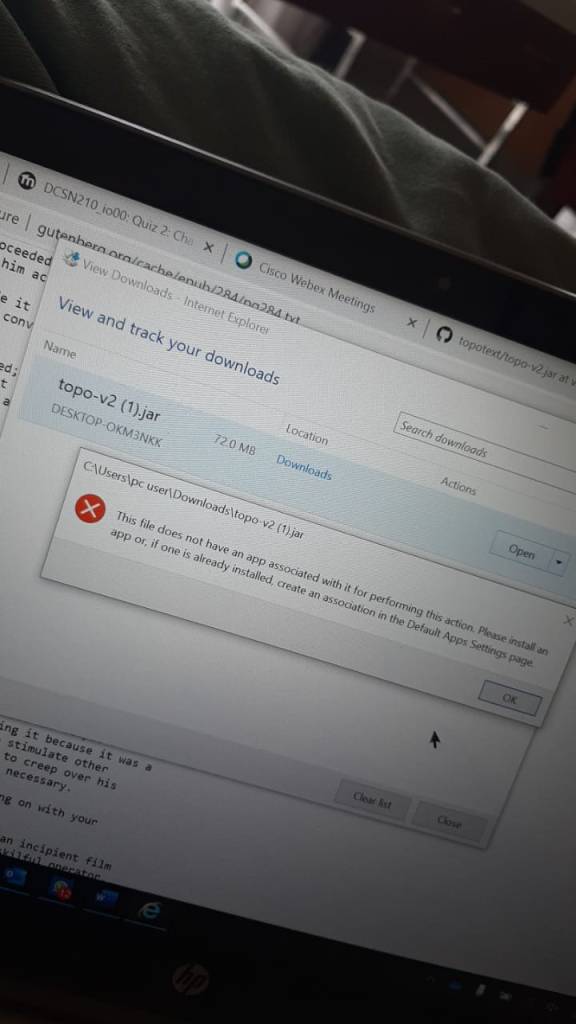
In order to map a text, you will need the important locations mentioned in a text. This is where our professor suggested Topo text, a digital tool that can extract locations from a novel into an excel sheet so it can be imported onto Googlemymaps. However, downloading topo text was a hassle. Firstly, we went on topo text website, downloaded the application, then we needed to download another application that supports topo text called “Breezipp”. After installing “Breezipp” we tried to access topo text however an error message popped up. We did not know what to do and it was a Saturday therefore we did not want to annoy our professor on a weekend. Hence, my colleague Mohamad called his friend from another group named Bob Issa and asked for his help. Bob advised us to dump topo text as he already tried working on it and the application always crashed and did not give him any results. Taking Bob’s advice, we moved on and tried mapping the texts manually and this is how it went.

To begin with, we started digging for information on our candidates from all sorts of websites such as Wikipedia, google and Enotes and the plain text format of the novels. Secondly, we fired up GoogleMymaps. Each member of the group handled one author. In order to have clear visuals, we mapped each author with his respective novel on a separate map.

Here’s what we got for Charles Dickens:

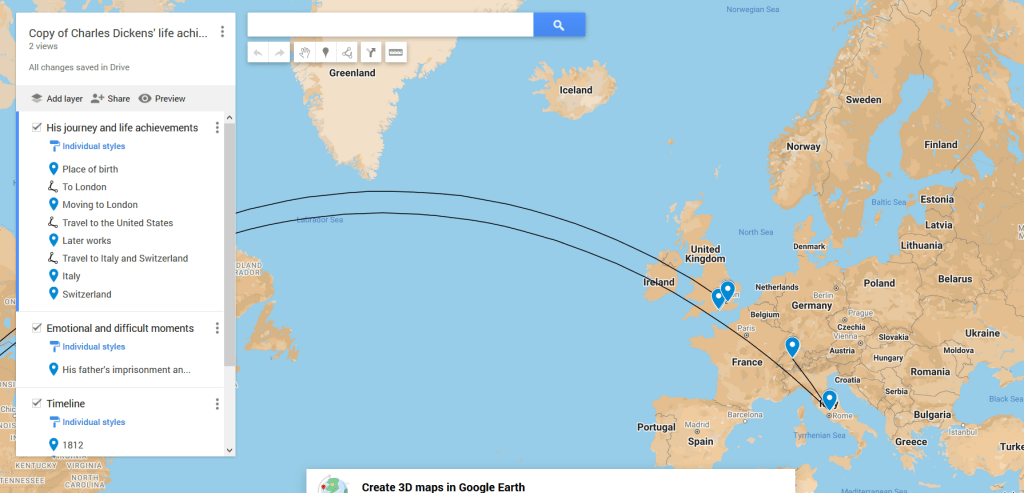
Charles Dickens, the author of Great expectations, faced various many struggles in his early life. Indeed, his family encountered financial difficulties. In addition, Charles Dickens described himself as a “very small and not-over-particularly-taken-care-of boy”. Nonetheless, Charles Dickens read a lot of books such as the works of Tobias Smollet. We could hypothesize that his thorough readings might have contributed to his writing style. A major milestone in his life was when he had to move to London with his family and his father got imprisoned due to increasing debts. Later, he had to stop school to work in a warehouse to support his family. During his time there, he witnessed the poor environment in which some people lived and this might have influenced the settings and the characters he chose for his novels. Other notable achievements include his claim that for at least three years he attended the theatre. We might also hypothesize here that this might have influenced his writing style. It is also said that some of his characters were inspired from one of his lovers such as Maria Beadnell who supposedly inspired him for Dora in the novel David Copperfield. He later undertook a career in journalism and that is when popular novels of his started appearing. However, what we learned the most after mapping this author’s life, is that sometimes an author has to experience an environment in order to understand it well and write vividly about it. Indeed, we believe that the fact that he had to work in a warehouse when his father got imprisoned and that he lived in a poor neighborhood before he moved to London influenced his choice of the story elements of Great Expectations. Thus, we could conclude that it is the environment in which Charles Dickens lived that impacted him and allowed him to write with precision and vitality the story of Pip and how he lived in a poor entourage before receiving his fortune.  

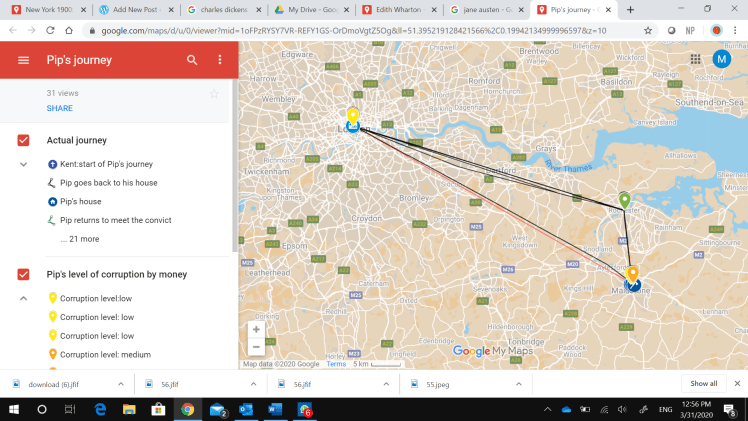
Moving on to the mapping of Charles Dickens’s novel, we proceeded in the following way: we focused first on one layer which illustrates with precision the journey of Pip, Great Expectations’ main character. The other layer focused on the level of corruption of Pip by money. We chose this aspect as our second layer since it related well to one of our main research questions of the project: how money influences the morality of people who possess it. In our map, the color red indicates a high level of corruption by money while the green color represents an almost absence of corruption by money and the gradation of colors in between indicate intermediate levels of corruption by money. Also, we were able to describe some of the emotions felt by Pip at different stages of the story in the same layer. Mapping Great Expectations helped us focus much more on the settings of the story. While we only viewed Kent and London as mere places in the story, we started noticing the contrast between both of them. Kent is where Pip starts out in a poor family but when he receives a fortune form an anonymous source, he travels to London which is where he manifests his acquired wealth. On the other hand, we also noticed that Satis House is where we encounter the main problem of the story, and also where it ends. Further, we were able to observe the level of corruption of Pip by money as he moves from one location to the other. It is at its highest once he gets to London and it is seen in the attitude he adopts with Joe when he later meets him again in the story. It is worth noting that Pip’s level of corruption by money increases throughout the novel up to a certain level and then goes back down. An interesting point is that Pip’s level of corruption by money starts to increase once he meets Estella at Satis House and almost ends when he meets her again at Satis House at the end of the novel. In addition, mapping the text made it look more ‘’true’’ than when it is read since we describe the events and mark them as locations on the atlas, giving the impression that the story really happened..

Jane Austen was born in Steventon in the year 1775 on the 16th of December. The atmosphere as Austen’s home was described is ‘’open, amused, easy intellectual one’’. We also know that during some evenings she read aloud novels with her family, some of which she had composed herself. This might have contributed to Jane Austen’s style of writing. Also, during her teenage years she wrote three short plays. During these same years, she also compiled Juvenilia which consists of twenty-nine works. She did all of this before even reaching her twenties. Later on, her family moved to Bath, which bothered Jane Austen since she was very attached to her home at Steventon. Consequently, she felt depressed and could not write as much as before. Then, she went back to Basingstoke where she received a marriage proposal which she eventually declined. She then went on with writing many more famous novels such as Emma, Pride and Prejudice, Sense and Sensibility. At the time, women had to have a male relative to represent them when published in their name, and thus Jane Austen had to be published anonymously. However, this did not stand in the way of her novels becoming very famous. She even received an invitation from Prince Regent who was an admirer of her novels. In the case of Jane Austen, mapping her life has helped us understand more the possible roots of her talent and fame. She was close to literature form a very early age and she wrote many novels in her teenage years.

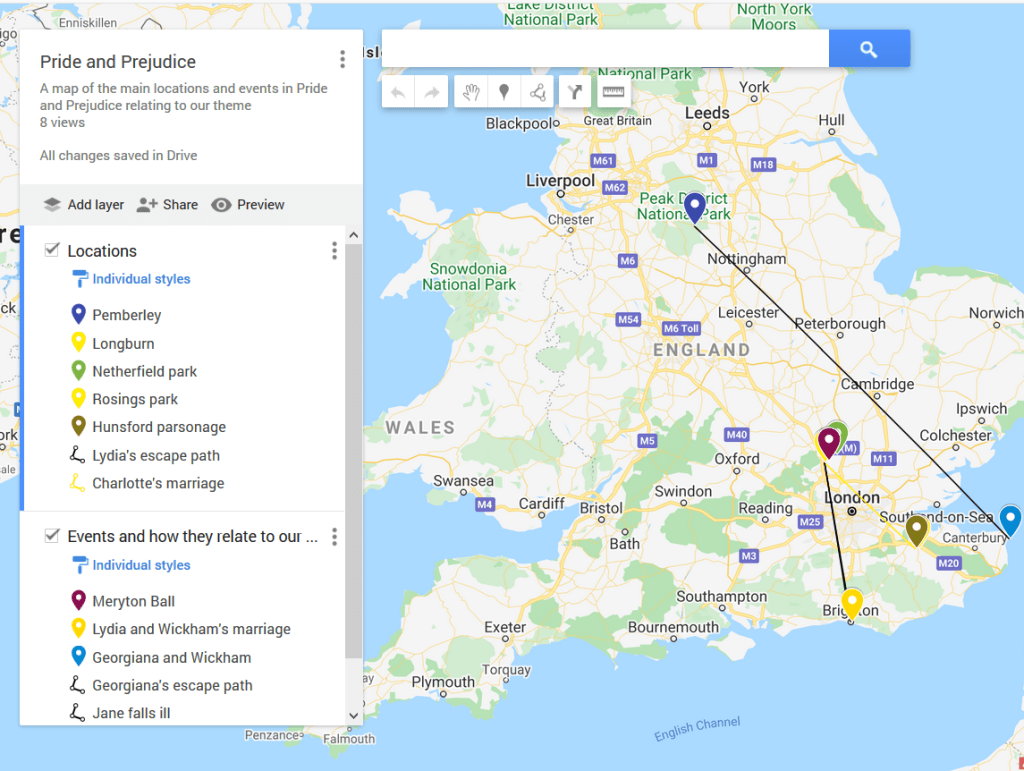
Regarding Pride and Prejudice, we also mapped the novel in the form of two layers. The first layer consisted of the main locations of the story. Among them, we can observe Pemberley, Longbourn which are located in England. For each location in the first layer, we simply stated their role in the novel but not which events take place in those locations. For our second layer, we outlined the major events of the story and indicated at some points how they related to our theme of money and power. The question to which we could answer effectively was the second: how does money affect the morality of people? In some of the events, we can observe a few marriages which are based solely on money such as the marriage between Wickham and Lydia. Indeed, Jane Austen’s plot reflects the dependence of women on marriage in the quest for social standing and financial security. Mapping “Pride and Prejudice” helped us also discover some locations of Great Britain through the various events of the novel. Moreover, the setting in which the Bennets live is rather small. They did not get the chance to fully experience the world around them. This might serve as a reason to why they only look for money as a decisive factor for marriage, because their lifestyle and way of thinking might be restricted. However, Jane Austen demonstrates that dramatic events can still happen even in a restricted and unexciting place. On the other hand, mapping the script made it closer to reality and more relatable. Jane Austen, who is British, was able to reproduce her experience in the cities she has visited during her lifetime into believable and relevant events through her writing.

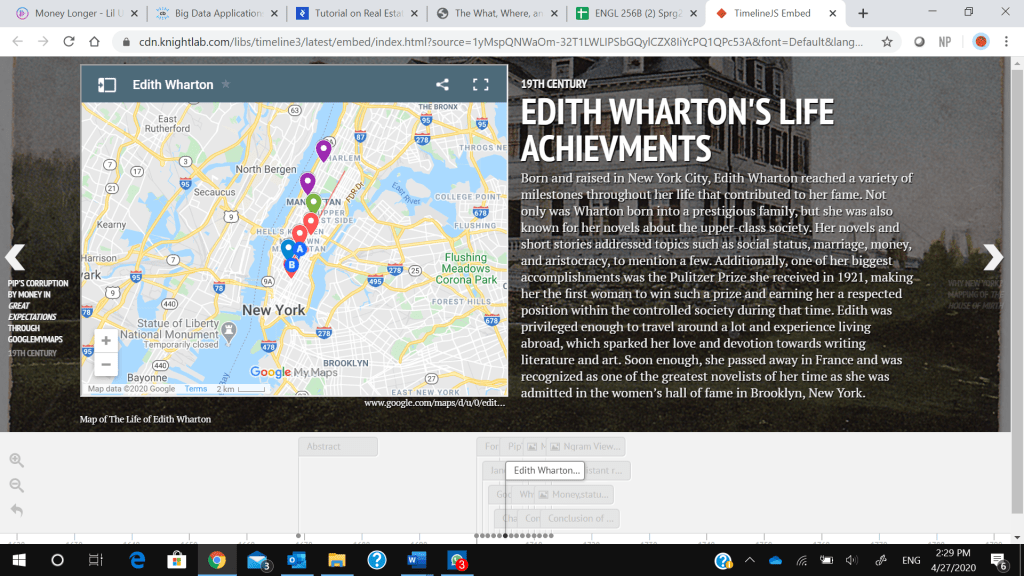
After mapping Edith Wharton’s life, we were able to discover a lot on Edith. Edith was born and raised on 14&23rd St. New York city, and shortly afterwards Edith got baptized in Grace church also located in New York city. Edith came from a rich family called “The Joneses”. In fact, her family was so rich that people came up with the saying “Keeping up with the Joneses”, a phrase still used to this day and has a famous Hollywood movie casted by known actors such as Isla Fisher, Gal Gadot, Zach Galifianakis, and Jon Hamm. In 1868, her family traveled to Europe where they lived in Rome for 1 year, moved to Spain, and finally settled in Florence. Due to her living abroad experience, Edith developed a love for arts and writing. After getting married in the trinity Chapel in New York, Wharton continued writing and wrote her way to Pulitzer in 1920, the first woman ever to win a Pulitzer Prize presented by the university of Columbia in New York. After a historic life full of achievements Edith Wharton passed away in August 11th, 1937. However, she was buried in France in the “Cimitiere des Gonards”, a far place from what she called home. After her death in ’37, on the 76th Hall street near the University of Columbia, the female writer was admitted in the women’s hall of fame as one of the greatest novelists that lived.

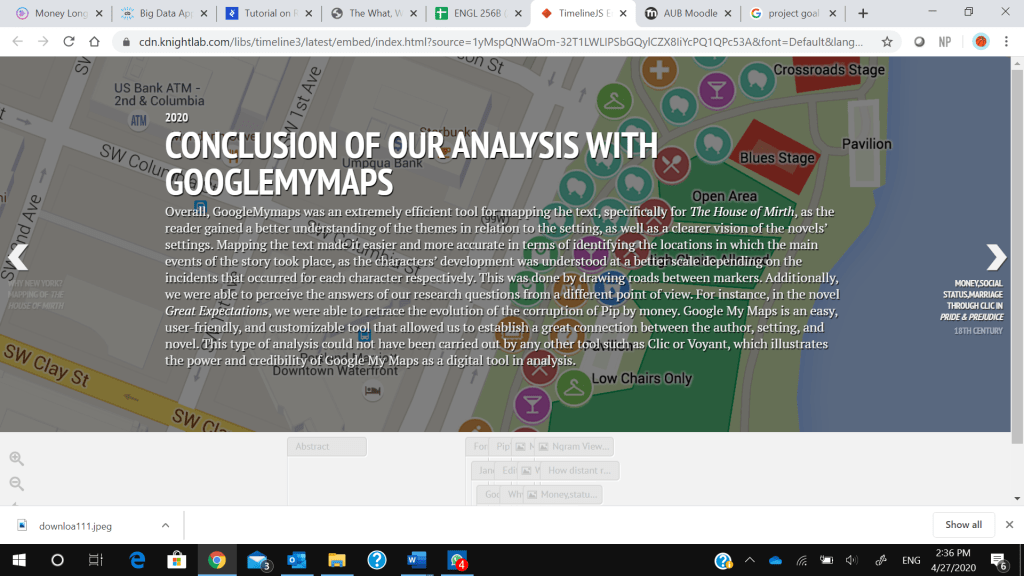
A final result of the ‘House of Mirth’ map gave us a clearer, more realistic, and exciting view of the novel. Now, we were able to connect the dots and visualize how the events took place in time and space. We can notice that all major events of the story happened in one block of the big apple, precisely between the 5th and 6th avenue, such events are how Lilly Bart, the main character of the story met Lawrence Selden, and how after major turnover in the novel, Lilly always went to 5th Avenue to wonder and clear her mind off things etc. Moreover, after mapping the life of Edith Wharton we can maybe now relate why she chose this setting. Edith’s childhood home was placed near the 5th avenue, and it could have been that she chose the avenue because she knew it by heart, which allowed her to feel the setting while writing the novel. The map appeared to be more accurate than the text as it was much easier to pinpoint the different locations that contributed towards the setting, compared to a relatively long text. Hence making it simpler to understand the specific elements that the setting encompasses such as the time, mood, location, and culture. Mapping Wharton’s achievements and works gave us a better insight on who she was as an author according to her accomplishments in writings that included topics such as social status, marriage, and money, just to name a few. This completely reshaped the way we viewed her as we learned more about what milestones she has reached and how much of a respected individual she has become in her community.

Exploring GoogleMyMaps has been a very positive experience overall. To begin with, the tutorial on YouTube was extremely helpful. In just fifteen minutes it explained to us almost all there is to know about this tool, starting from how to name our first layer to how to draw roads between two different markers. In addition, My maps is user friendly and customizable, where you can add photos, change markers and icons, and navigate through colors. We did not encounter many inconveniences, although drawing a road between two locations was a bit tiresome when the locations were far apart. However, the hard part was not using Mymaps, but rather gathering the information needed to map as websites did not offer enough details. Moreover, regarding the life achievements of the authors, you can rarely find the specific location of where something happened. Achievements are more often referred to by dates instead of places i.e. if someone won an Oscar, the websites states when he won it and what for, but not on which stage he received the prize.

In conclusion, mapping a text is not always as easy especially when we want to represent the story efficiently but also without including too many details. Nonetheless, the advantages outweigh the disadvantages as mapping allowed the story to make more sense as it sets the mood of the novel and helps us relate the plot to the settings well. From the authors’ perspective, it gave us a more thorough knowledge about their life achievements. Moreover, we discovered that mapping an author’s life can draw a connection between the author and his/her novels which assists us in gaining a better understanding on why certain places and timings were chosen for the events of his/her novel. Of course, it is thanks to GoogleMyMaps which allowed us to engage in this interesting distant reading of the novels.

Money and Power Through The lens of Three Authors

By Mohamad Mrad, Alessandro Al Khoury and Maha El Solh

Through the beginning of time the concept of money always existed, even before it was created. First it was in the form of a non-monetary exchange when two people would trade something they own with one another. Then, in the romans period it transmitted to the form of coins that had the emperors face on it. In later times, this metal coin was reshaped to a paper bill and today we are in the process of witnessing a new shape of money, a digital virtual currency called “crypto”. Who cares about the shape of money as long it is doing what it has always done. Nevertheless, what do you think money does? Or did? buy you groceries? Furniture? Women? Social status?  The concept of money had been established before the beginning of written history but how was that concept viewed before our present time.

In this blog we shall analyze the concept of money & power in the works of Charles Dickens’s “Great Expectations”, Jane Austen’s “Pride & Prejudice” and Edith Wharton’s “The House of Mirth”. All of these novels are written in the 18th and 19th century. CLIC and VOYANT are two digital humanity tool designed to help users analyze texts by displaying word frequency lists, frequency distribution plots and much more. With the help of these two tools we will answer these following questions that support our theme.

What are the kinds of power that money grants to people in the 19th century?

What is the influence of money on the morality and mentality of people?

Is money described as good or bad throughout the corpus?

In order to answer the first question, we opened CLIC, accessed the concordance category and ended up with the following results.

At first, Analysis on “Great Expectations” yielded with expectable results, money offers education and survival.

However, with some more digging into the long word lists of CLIC. We learned was that money was associated with greatness in a family:

Thus, we may infer that money offers social status too.

The following quote also indicates that money is not only associated with liberty but also with the ability to become a gentleman at the time.

 This inference is further reinforced when we shifted to “Pride and Prejudice”:

The next quotes offer further support and expresses that money is not only a necessity to live well, but to just live all in all.

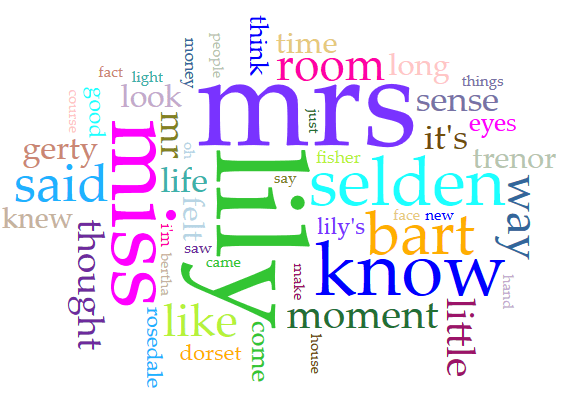
Now, to introduce “The House of Mirth” into the flow, we had to employ the Voyant tool since the novel isn’t available on CLIC. The Cirrus Cloud function gave us the following results. We note that money is repeated 113 times and is on the top left corner of the cloud. Indeed, the main character Lily seeks marriage in order to secure herself financially and access the upper class. Thus, money gives power to men who possess it concerning marriage which already shows us that money plays a major role in the story.

What is the influence of money on the morality and mentality of people?

“Great expectations” emphasize the fact that money corrupts people. In a way, we could say that money pushes people away from living a simple and nice childhood (‘boyhood’ in the quote).

In addition, the following quote hits the mark regarding money’s effect on people: “She seemed much older than I, of course, being a girl, and beautiful and self-possessed; and she was as scornful of me as if she had been one-and-twenty, and a queen.” Here, the main character, Pip walks with Estella, a girl raised by a rich woman. The quote strongly shows how Estella’s possession of money makes her carry herself with Pip. This proves how money corrupts people to the point that they believe money is superior to human relations, one of the main things that constitute our humanity. Despite this, we were surprised that when Pip got suddenly rich, he started acting in the same way…

“Pride and Prejudice” is even more precise. Jane Austen indirectly asserts that needing money and seeking it is similar to suffering:

And this suffering harms the mind and the morality and forces people to act in ways that are wrong. It makes them put money as an essential component of their lives:

The following quote also illustrates how sometimes money can determine whether marriage will proceed or not:

However, “Pride and Prejudice” pushes us further in, it shows how money can force women to make marriage the central purpose of their life (fifth quote).

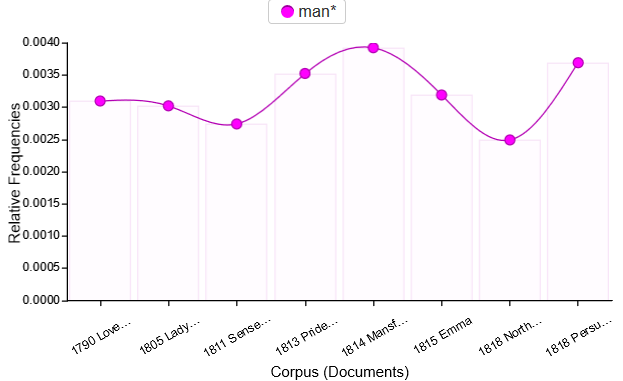
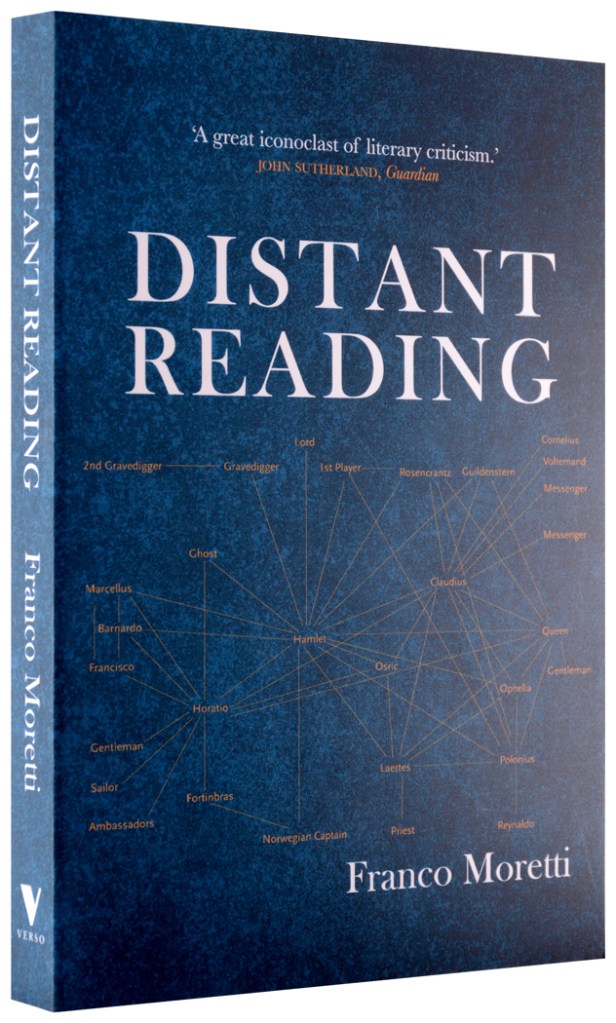
Indeed, during this period, women were regarded as dependent entirely on men to survive and why was it so? Because of money. Therefore, another way in which riches corrupts human mentality is that it becomes the scale by which to measure the success of a marriage. And we all know that marriage should be built on other foundations, much more noble than wealth. This graph from Voyant (slideshow) gave us more novels than we asked it for, but it still shows that the word “man” is the most repeated in “Pride and Prejudice” compared to Austen’s other popular works. This increased usage of the word reflects in a way the superiority that is granted to men solely by the possession of money.

Next, we will take a look at how money compels, especially women to seek marriage in order to preserve their social status. This is mainly seen in “The House of Mirth”. On the other hand, Lily sees poor people as inferior. This is another way by which money corrupts people. The word “pigs” appears 3 times throughout the novel. In fact, Lily says that poor people are “living like pigs”.

A third aspect of how money corrupt Lily’s morality is that her desire for it makes her a slave to money. In the novel, she engages in gambling which leads to her accumulating many debts.

Thus, with all that information gathered, we may also answer our third question.

Is money described as good or bad throughout the corpus?

At this point, I believe the reader can easily deduce that money is depicted as a bad thing. Although money offers some benefits as previously mentioned it creates disequilibrium between people which lead to the classification of people (social classes) which in itself is debasing to humanity. Even worse, it corrupts people and can turn good people like Pip into snob and condescending people.

Our experience using CLiC and Voyant has been remarkable. Analyzing all texts with CLIC and Voyant was easy. We could immediately get results for word counts at the “CLIC” of a button. Nonetheless, we thought that CLIC was more effective than Voyant in providing context for the words we searched for. For example, if we looked for the word ‘’money’’ on CLIC, it gave us directly a few words that appeared prior to and after “money” so that we could get the context of the word. While Voyant had other options for phrases, we found the Cirrus cloud function of Voyant very useful to our analysis for comparing word counts in general.

At first, it was a bit difficult to get accommodated with the features of both tools since they were many, but later we got used to it and the process became much smoother. We believe that the features that we have exposed in this blog may be enough for us to complete our digital humanities project. Nonetheless, we might refer more thoroughly to some tools to make our analysis more precise (maybe use more graphs from Voyant in the final project).

One of the main advantages of distant reading is that it provides us with a vast array of results in a matter of minutes. In addition, it helps us in evaluating our results objectively. In close reading, by contrast, the reader might refer to his judgement and subjectivity. On the other hand, referring to tools such as Voyant and CLIC may not provide us with a complete picture of a certain novel. Indeed, these tools give us a general idea of the main themes, the settings and the main characters of the novel. However, some readers might be interested in some precise details of the novel. In this case, a distant reading approach might not be the best solution.

My Digital World Narrative

The digital world in Lebanon did not welcome me that much. Between my impatience for the slow-mo internet connection and adapting to this whole new blog thing, I was already considered an outsider.

I regard myself as an old-fashioned pen and paper guy, where I scratch everything I don’t like, and get satisfaction out of seeing it on my paper proving my willingness to work. My usage for computers and digitals devices started accumulating when I first entered university, that is when I was introduced to the AUB student information system to register for courses and financial aid. Alongside the first course came my first assignment on the infamous Moodle or what I thought was called noodle at the time. To the naked eye, Moodle is a normal academic platform that is used to submit assignments, deliver academic content, and more. Nevertheless, to AUB students, it is a platform that can be accessed from laptops, tablets, phones, and any digital device. I never knew the importance of such a platform until my previous semester at AUB when the Lebanese revolution started. Moodle delivered full courses’ contents, live interactive video lectures, and exams. Education was literally delivered to our digital devices as simple as that.

 Now let me tell you how I waste my time on social media scrolling through news, events, and other people’s lives. Every morning I wake up with Instagram, chat with snap over lunch, and since I do not have twitter, I sleep with insta too. However, I can’t say that social media totally threw me in the can. As I am mostly interested in both business and sports, social media allows me to be constantly updated on their news and practically anything I am interested in. I wouldn’t necessarily say my world revolves around technology, but I think almost everyone is guilty of living in a digital world subconsciously, and it’s just how the world works at present. Usually I am very busy with my life that I don’t have time to read a full 400-page book. Social media such as blogs, twitter, e-news etc. gives me the opportunity to read what intrigues me the most in a small matter of time as well as to interact with people and gain knowledge. For instance, I follow Bloomberg Business on social media, which updates me on business news and events all around the world. I engaged in an interesting conversation with a guy who “Dm” me because he recognized my Arabic name and was interested in the Lebanese dollar situation. Although I am almost sure Marc Zuckerberg did not intend for this, but my writing skills did also develop due to my finger constantly scrolling through feeds. I am not sure how he did it but that’s why he’s a billionaire and I am here writing this blog. No offense to my new blog writing community.

If I’m being honest, joining a new online community always comes with a fresh and exhilarating feeling. For example, I can recall the time I joined a sports community in Qatar on LinkedIn. I felt like I was part of something bigger, which developed into a sense of belonging. A lowkey feeling of being more important or successful somehow. It’s always enjoyable to keep up with social media and trends in general as since everything is accessible online, there are definitely some things that I can count on as a conversation starter.

I can definitely say that I’ve had my fair share of struggles and challenges dealing with the so-called digital world. What feels like a split of a second while I’m checking Instagram for my ‘5 minute break’, is in fact a good 2 hours spent procrastinating on some random person’s page on a completely irrelevant application. I remember a phase of my life when that floppy bird game always got the best of me and everytime I opened my phone, I found myself playing that stupid game. 

My understanding of digital technologies stemmed from my personal experiences that had created a safe and easy space for me to be able to communicate with the people closest to me, when realistically they were the furthest. That is, especially when half of my friends left to study and work in other countries. This entirely changed my perspective on social media as I realized how attached I could potentially be, without completely admitting it to myself. It has shaped me in a certain way that allows me to balance my time between the real world and the digital world. However, I do come to the realization at some point that it has taken over my life to an extent, and I lose my ability to control it as even academically, I am very much dependent on social media as an outlet to refer to continuously. To this day, I am unable to grasp the concept of being able to find everything online and in such a simple way that baffles me. Frankly, it shows me what it means to be living in a digital world. Worldwide news is spread like a fire among stubble, people become famous in a period of hours to an extent that is somewhat questionable, and academic research is easily attainable to people of all sorts of levels.

To conclude, the rapid development of technology in general has had a major impact on me as I am 100% guilty of depending on social media as my escape from reality on a daily basis. After all, there is no denial that it is a basic necessity in order to keep up with the digital era that is constantly evolving.

Design a site like this with WordPress.com
Get started