
Today is the day, the day we are posting our final blog for this course, our English 256B course. We have come along way since the beginning of this semester, specially while everything happening in the world from the corona pandemic to a possible economic recession. In this final blog we will write a reflection on our final Dh Project, which by the way if you haven’t seen it, here you go Money & Power. Our reflection will include what is and why we chose our theme and our novels, the goals of the project and whether these goals have changed with time and research, and finally and most importantly, the new things we have learned about our topic in addition to how digital tools helped us learning along the way. Since this is our last Blog let’s make it worth it.
Why this theme and authors?
As a theme for our DH project, we have chosen Money & Power in the works of Charles Dickens, Jane Austen and Edith Wharton. In exact, we chose one novel per author, Pride & Prejudice, Great Expectation and The House of Mirth, Respectively. At First, we chose a corpus consisting of novels written by Nicollo Machiavelli. However, with some more research we found it more interesting if we talked about a theme rather than choosing one author. Therefore, since Mohamd and Maha are business students (they like money) we found it interesting to address the theme of Money & Power. After some research, we found those three authors who are known for their writings on such concept. We got the green light from professor Najla and the journey started.
Our goals:
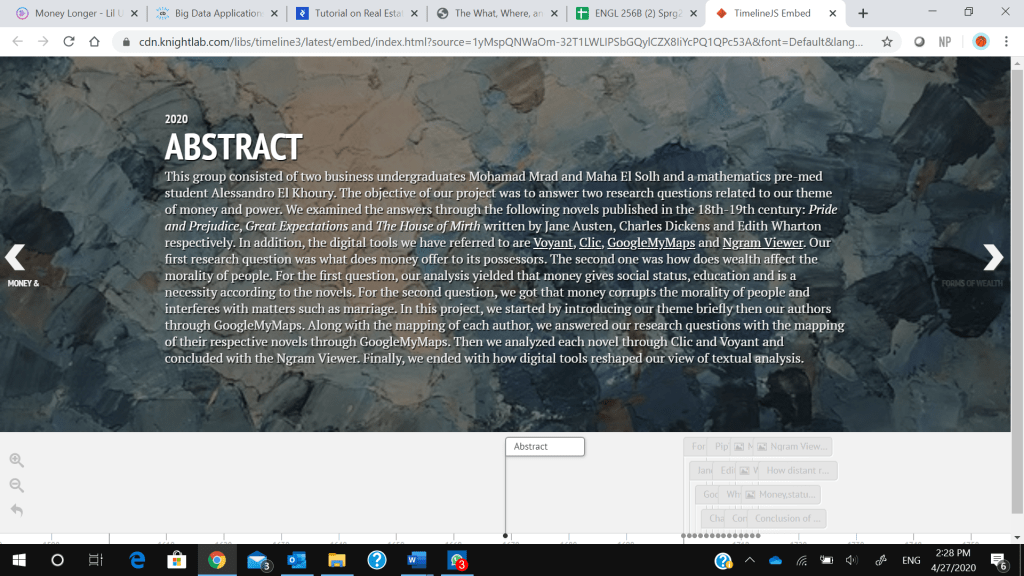
The main goal of our project consisted of two research questions related to our theme, what money offers to its possessor and how does money affect morality. We believe those two questions are important to ask as they are part of the major effects of money in society. In order to accomplish this goal, we had three sub-goals. The first one was to present a mapping of each novel with GoogleMyMaps. The second was to analyze each novel with Voyant and Clic. After analyzing all three novels, we were able to produce solid answers to each of our research questions. All three novels indicated that money brings social status and it also guarantees education. Regarding our second research question, we obtained that money corrupts one’s morality. This was seen in Great Expectations’ Pip. After receiving money form an unknown source, he started acting in a condescending way towards Joe. This was also seen in Estella’s attitude towards Pip the first time they met. On the other hand, money also interferes with marriage as seen in all three novels. It turns itself into the deciding factor for whether marriage will happen or not. As such, it is the foundation, such as love and chemistry on which a successful marriage is built. Therefore, after digging out all the relevant information we needed from our digital humanities tools, we were able to generate answers to both of our research questions. Consequently, we believe that we were able to achieve the destinated goal of our project.
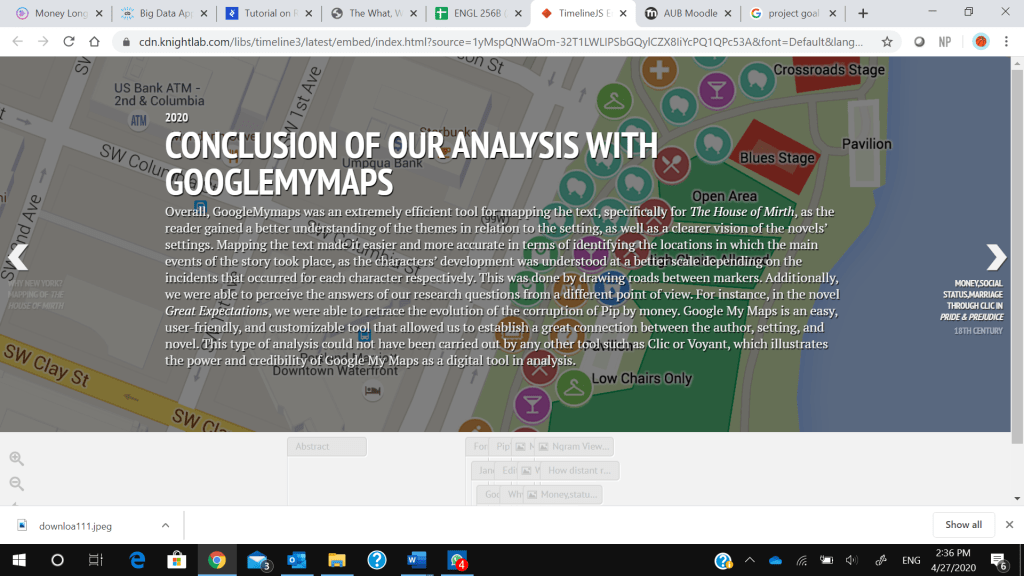
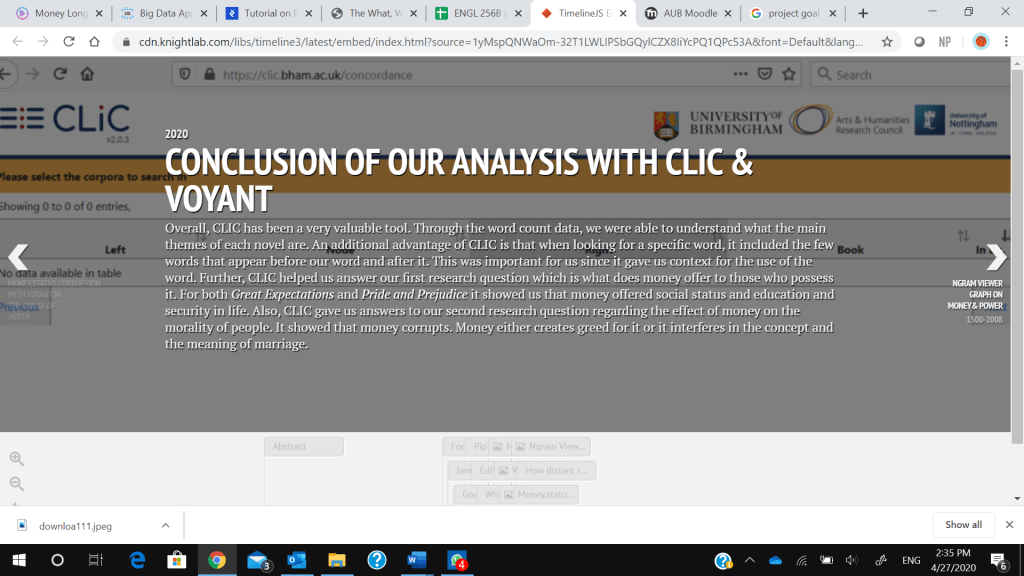
Furthermore, we should note that we did slightly modify the trajectory of our project. Indeed, after we deeply analyzed our novels, we decided to give more emphasis to our second research question; how money affects the morality of people. In fact, while the three novels did give us answers to our first question, we noticed that the second question constituted a more prominent topic in all three novels. We see it in how money affects marriage in the plots, how Lily seeks it to secure herself financially, how Pip sees money as the only way for him to be able to marry Estella and how the Bennets prioritize marriage for the purpose of material gain.
How DH tools gave us new knowledge on our Topic and Authors:
A casual reader would skim through a novel as an enjoyable activity that piques his interest. However, approaching novels from a different perspective allows the individual to gain a deeper understanding of the reasons behind the author’s purpose. For example, by mapping the works of Jane Austen and the stages of her life, we were able to correlate the impact of the areas she lived in and travelled to, with the outcome of her work. It gave us a new perspective and understanding of the environment Austen resided in and the family she grew up with. Austen used her life surroundings to add more value to her content. Moreover, from today’s perspective, one would consider most characters in Austen’s work to be shallow and money-driven when it comes to their reliance on marriage as a solution for economic security. However, by looking into the culture at the time, and the impact money had on the social status of everyone, one would consider that behavior to be quite logical and understandable. Furthermore, by developing a timeline and mapping Austen’s work, along with Charles Dickens’ and Edith Wharton’s, we were able to observe a continuity in this money-driven ideology.
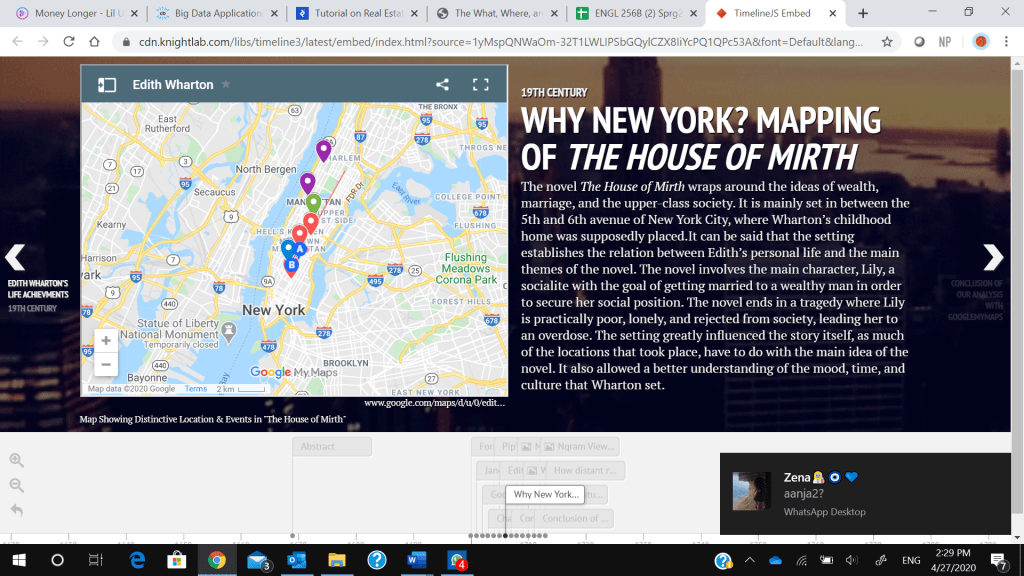
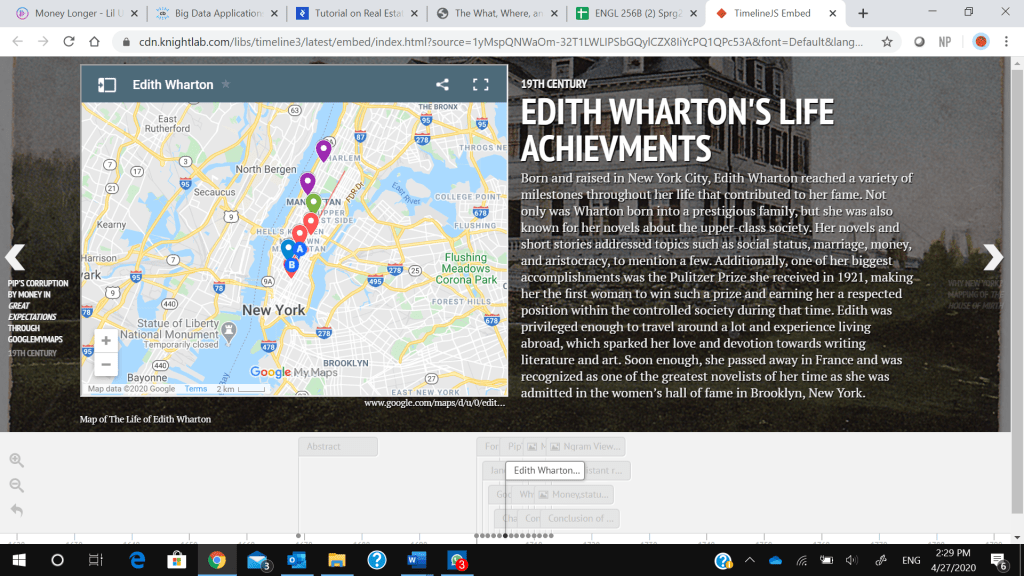
Furthermore, in Wharton’s work, one can observe a certain vagueness when it comes to geographical descriptions of her character’s locations and origins. Thus, showing that the author adequately described places she knew from experience. However, a naked eye could have not noticed this matter, but it was brought to our attention after mapping her life achievements and novel.
At the time Dickens was writing, people of noble birth were no longer the only wealthy members of the society. Middle-class people were able to gain a new social status and rise to wealth by running a successful business, such as factories, and through hard work. The importance of money is evident in Dickens’ work, but the means to reach wealth and status were different. Moreover, it also fostered a negative mentality which is that anyone can succeed and become wealthy with required efforts, and therefore, poor people were viewed rather as lazy.
From our project, we were able to develop a general understanding of marriage to each gender at the time. For women, marriage becomes a mean for social and economic security, as well as being owned. However, for men, marriage is a mean to utilize their wealth, thus allowing them to choose a wife freely and dominating her. Marriage was considered as an acquisition and an ownership of a woman.

The digital tools we referred to were extremely helpful in building our analysis. GoogleMyMaps showed us that great writers may fabricate fictional stories. However, they use settings and emotions derived from real surroundings. Clic and Voyant pointed us keywords in the novels related to our theme as well as quotes that allowed us to answer our research questions. The Ngram Viewer was also helpful as it drew to us the correlation between the words ‘’money’’ and ‘’power’’ throughout the 18th and 19th centuries. Furthermore, the platform of our project, TimelineJS, organized all our information and visuals into one place with style and clarity. TimelineJS is divided into slides and a time axis which allowed us to partition our work into well-defined categories. Thus, the digital tools previously mentioned helped us gather all the information while TimelineJS arranged it into a clear summary of our work.
 BasketBlog